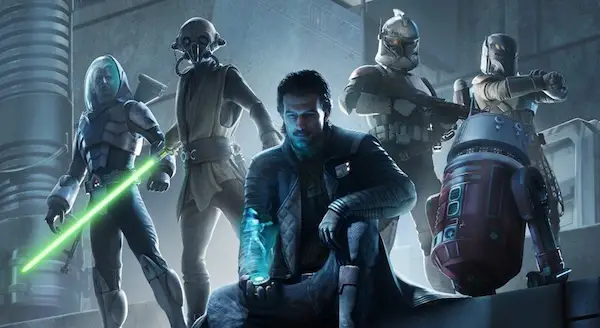
I came to Star Wars Zero Company for the Star Wars, not for the tactics. I have said throughout this series that I am not an XCOM player and that my gaming background is almost entirely Galaxy of Heroes. What I expected was a competent strategy game with a Star Wars skin stretched over it. What I got is one of the better-written Star Wars stories in any medium in recent years, and I want to spend a same amount of time on why.
If you played Star Wars Jedi: Fallen Order and came away feeling like that game understood something about this universe that most Star Wars games do not, you are going to feel it here too. That is not a coincidence, and it is not just vibes. Aaron Contreras was the narrative director on both Fallen Order and Jedi: Survivor, and he is the narrative and cinematic director on Zero Company. Different studio, different genre, same person shaping the story. Once you know that, the resemblance stops being surprising and starts being the entire point.
What both share is a willingness to make the small story matter more than the big one. Fallen Order worked because Cal Kestis was a nobody in a galaxy that had already lost, and the stakes were personal long before they were galactic. Zero Company runs the same play. Hawks is a broken-down former Republic officer running a unit that cannot pay its bills, and the opening chapters are about a debt to a Hutt, not the fate of the Republic. Bit Reactor has described the game as being about the war beneath the war, and that framing holds up. The Clone Wars are happening somewhere over there. You are down here, doing the ugly work nobody will write about.
The characters are what carry it. Zero Company builds a squad out of people who have genuinely good reasons to distrust each other — a clone trooper, a former Separatist partisan, a Mandalorian, a mercenary, and others who arrive with histories that do not fit neatly together. The game does not smooth that over. It stages actual confrontations between operators in your own base, and then makes you decide how Hawks responds. Because the relationship system has mechanical weight, those conversations are not optional flavor. Who gets along with whom changes what your squad can do on the battlefield.
The pacing deserves credit too, because this is where games in this genre usually fall apart. The opening missions are deliberately narrow — they teach you the mechanics and set up the story, and they do not ask much of you tactically. Then the game starts varying the terrain and the mission objectives on a regular basis, and that variety is doing real work. A tactics campaign lives or dies on whether it can stop feeling like the same fight in a different color, because once players sense they are repeating themselves, they burn out and drift away. Zero Company keeps moving the ground under you often enough that it never settled into a routine for me.
I will say this much without spoiling anything: a very famous Jedi shows up partway through, and not as a cutscene walk-on. You get to control them for a stretch, and the mission built around that appearance is the best in the game to this point. The timing is what impresses me. It arrives at almost exactly the moment the campaign could have started feeling repetitive, and it resets your attention completely. I am deliberately not naming them here. Anyone who plays will know exactly what I mean when they get there.
And there is a turn later in the campaign, somewhere in the high twenties in terms of missions, that I am not going to describe at all. It recontextualizes the entire story and shifts what this game is about. By that stage you have spent enough time with these characters that you are actively anticipating certain things happening, and the game knows it — it uses that anticipation to build tension rather than just delivering a surprise. The result is that the back half gives your operators a renewed purpose instead of coasting to a finish. I went in unspoiled and I am glad I did, so I am not taking that from anyone. Just know it is coming, and that it lands.
The tactical layer is good, and by now I am genuinely enjoying it after a rough start. But if someone asked me whether to buy Star Wars Zero Company, I would not lead with the combat. I would tell them that this is a well-written Star Wars story about a group of people who should not work together, that it treats its own universe with real seriousness, and that the person who wrote the last two great Star Wars games wrote this one too. The tactics are how the story gets told. The story is the reason to show up.