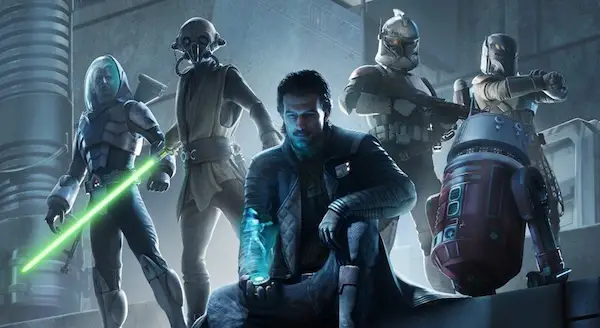
The through-line of this series has been a Galaxy of Heroes player learning a genre from scratch. In the first article I could not figure out how to move. In the third I lost an afternoon to a bacta tank. By the fourth things had started to click.
This entry is the one where Zero Company stops holding anything back. Two new operators, the best mission in the game so far, and a progression system I did not know existed until it appeared on my screen.
Cly Kullervo and the Mandalorian Problem
Before Umbara, we picked up Cly Kullervo.
Cly is the Mandalorian, and he was one of the squad archetypes EA put front and center back when this game was first announced. He is also the only character in the game who can wear Mandalorian armor — the cosmetic wardrobe is otherwise shared, but that is his and his alone. If you have been eyeing Mandalorian gear in the customization menus and wondering why you cannot equip it, that is why.
Adding a Mandalorian to a unit that already includes a clone trooper and a former Separatist financier says something about what Zero Company is. This is not a Republic special forces team. It is a collection of people with incompatible histories who happen to need each other, and the game keeps leaning into that friction rather than smoothing it over.
Umbara
Then comes the Umbara mission, and I want to be careful here.
Umbara is not a random planet. If you watched The Clone Wars, you know exactly what happened there: Jedi General Pong Krell took command of the 501st, deliberately fed clone troopers into a slaughter, and was exposed as a traitor working toward the Separatist cause. It is one of the darkest arcs in the entire show.
And Krell took that command because Anakin Skywalker was pulled away and handed it over.
Now go back to the opening minutes of this game. The first meaningful thing you learn about Hawks is that he served under Pong Krell, and that Zero Company was formed in the aftermath. I flagged it in the first article as a strong hook. I did not realize the game was setting up a payoff.
The mission is a prisoner exchange with the Separatists, and Anakin Skywalker is escorting the prisoner. Matt Lanter is back voicing him, and he sounds exactly like he should.
Anakin’s appearance in this game is not a secret — EA revealed him at the end of the Summer Game Fest gameplay trailer and StarWars.com confirmed his role in an official post. What the trailer did not prepare me for is how the game actually uses him. This is more than a cutscene walk-on. You get real time with him, across more than one fight, and it fundamentally changes what those encounters feel like.
I am not going to spoil what happens at that exchange or how the sequence plays out. If you have played it, you know. If you have not, go in cold. I will say that this is comfortably the best mission in the game to this point, and that it does something to the story that reframes what came before it.
What I will say about the design: putting Anakin and Hawks on Umbara together is not a fan-service coincidence. It is the campaign cashing a check it wrote in the tutorial. Bit Reactor set up Hawks’ history with Krell in the first ten minutes and then waited a dozen cycles to pay it off on the one planet where it would land hardest. That is patient writing, and it is not what I expected from a squad tactics game.
The Umbaran Who Joins Us
Coming out of that mission, we add another operator, and this one is uncomfortable in the best way.
He is an Umbaran sharpshooter who fought to defend his homeworld during the Republic invasion. He watched the Republic occupy his planet. He has no affection for the people who did it, and he is willing to work with Zero Company anyway.
Which means Hawks has now put a clone trooper and an Umbaran who fought clone troopers on the same roster.
The game does not let that slide. There is a confrontation between him and Trick about the Battle of Umbara that gets genuinely ugly — ugly enough that Trick comes to Hawks afterward and asks whether having him on the team is a good idea at all.
This is what I have come to appreciate most about Zero Company’s writing. It builds a squad out of people who have real reasons to hate each other, and then it makes you manage that. The Bonds system stops being a stat optimization exercise the moment two of your operators nearly shoot each other in your own base.
Second Specializations
The other surprise came out of nowhere: after a recent mission, I unlocked a second Specialization for my operators.
This opens up around Cycle 18, and it is a significant shift. An operator stops being one role and becomes a hybrid. My melee-heavy preference is a good example — pairing an aggressive close-range specialization with something that generates Advantage or hands out AP means the same character can close distance and set up the rest of the squad in a single turn.
A few things I am keeping in mind before spending points, having already made plenty of mistakes in this game:
- Cover a gap rather than doubling down. Making my best attacker marginally better is worth less than giving that attacker a support function the squad currently lacks.
- Check it against Bonds. Cross Training already lets operators teach each other passives. Picking a second specialization that duplicates something a teammate already gave them is wasted.
- Look at the roster as a whole. With Hawks, Trick, Kabb, Jae, BR-1, Cly and now an Umbaran sniper, a second specialization is the cheapest way to add a missing role without hiring anyone new.
The Shape of This Game
Something worth saying at this point in the playthrough: Zero Company back-loads its depth, and I do not think that is an accident.
My early articles documented a game that felt opaque and occasionally punishing. Movement prompts that did not explain themselves, a medbay that quietly locked me out of a mission, extraction objectives I misread entirely. Then the mid-game hands you Bonds, Cross Training, astromech AP distribution, roster depth and now dual Specializations in fairly quick succession.
The wall is at the front. Once you are through it, this game opens up considerably, and it keeps opening up. If you bounced off Zero Company in the first few hours because it felt obtuse, I would tell you to go back. What is on the other side is worth the friction.
TL;DR: The Mid-Game Turn
- Cly Kullervo joins as the Mandalorian, and he is the only operator who can wear Mandalorian armor.
- The Umbara mission is a prisoner exchange with the Separatists, and it is the best mission in the game so far.
- Anakin Skywalker appears, voiced again by Matt Lanter. His presence was officially revealed pre-launch, but how the game uses him is worth experiencing unspoiled.
- Umbara is Pong Krell’s planet. Hawks served under Krell, and Anakin was the general who handed Krell that command. The game set this up in the tutorial.
- A new Umbaran sharpshooter joins the roster. He fought against the Republic invasion of his homeworld, which puts him in direct conflict with Trick.
- Second Specializations unlock around Cycle 18, turning operators into hybrid roles.
- Build second specs to cover gaps in the squad, not to reinforce strengths, and check them against what Cross Training has already given each operator.
Twelve-plus cycles in, I have gone from a player who could not figure out how to walk to one who is thinking three turns ahead and planning roster composition around emotional friction between characters. That is not a small distance for a game to carry someone. More to come.