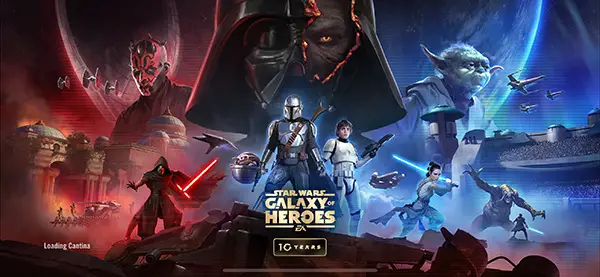
In a mobile gaming landscape that has seen major titles come and go, Star Wars: Galaxy of Heroes continues to stand tall in 2026 as one of the most stable and enduring Star Wars experiences available. With the Era of Anniversary now complete, the ambitious Era of Andor underway, and the game having officially celebrated its 10-year anniversary in November 2025, SWGoH finds itself in a fascinating position: battle-tested, mature, and still evolving.
A Decade of Galaxy Building
When Star Wars: Galaxy of Heroes launched in 2015, few could have predicted it would reach a 10-year milestone — let alone still be one of the flagship Star Wars gaming platforms in 2026. The November 2025 anniversary event, dubbed the Era of Anniversary, brought a surge of player engagement, nostalgia-driven content, and limited-time characters that reignited excitement across the community.
User activity spiked noticeably around the anniversary celebration. Longtime veterans returned to relive early metas, collectors rushed to unlock special characters, and competitive players recalibrated for new 3v3 and 5v5 Grand Arena Championship seasons. Like most major live-service events, however, that surge eventually normalized. Now, in early 2026, player numbers have settled back into their steady baseline — but importantly, that baseline remains healthy and sustainable.
In an era where many Star Wars games rotate in and out of prominence, Galaxy of Heroes stands as one of the few consistently supported mobile Star Wars titles still operating at scale.
Era of Andor: A New Chapter Begins
With the Andor-inspired content rolling into the game, the Era of Andor represents a tonal shift toward rebellion-era strategy and calculated team-building. The kits released during this phase emphasize synergy, tempo control, and layered mechanics — reinforcing the game’s modern design philosophy.
The Era of Andor characters, while temporarily restricted in some modes at launch, have “on paper” kits that look both thematic and mechanically deep. They reward thoughtful roster construction and expand options for players who enjoy strategic counters rather than brute-force Galactic Legend matchups.
For long-term players, this signals something important: the developers are not merely recycling nostalgia. They are still experimenting.
A Mandalorian Boost on the Horizon?
May brings another potential inflection point for SWGoH: the theatrical release of The Mandalorian & Grogu. Whenever a major Star Wars media event hits theaters, Galaxy of Heroes tends to experience at least a modest influx of returning and new players.
The game is uniquely positioned to capitalize on that interest. The Mandalorian faction is already one of the most beloved and diverse in the roster. If new tie-in content arrives alongside the film, it could create another short-term spike similar to what we saw during the 10-year anniversary.
More importantly, SWGoH remains one of the most accessible ways for casual Star Wars fans to engage with the broader universe — no console required.
The Competitive Core: Mods Still Matter
If 2026 proves anything, it’s this: mods still define the game. While relic levels and new marquee units dominate headlines, the real edge in competitive modes — Grand Arena Championship, Territory Wars, and Territory Battles — continues to come from proper modding. Small Speed differences, efficient slicing, and precise turn order tuning often decide matches before the first ultimate is activated.
Over the past year, we’ve significantly expanded our SWGoH mod coverage to reflect that reality:
- Beginner’s Mod Guide
- Advanced Mod Strategy Guide
- Mod Slicing Guide
- Character-Specific Mod Guides
- Speed Tuning Breakdowns
- 3v3 and 5v5 Optimization Recommendations
As the roster grows more complex, mod literacy has become the dividing line between casual participation and consistent competitive success. The meta may shift, but Speed, optimization, and efficiency remain timeless.
Stability in an Uncertain Market
The broader Star Wars gaming landscape has thinned in recent years. Major console titles arrive in waves, but few maintain persistent live-service ecosystems. In contrast, Galaxy of Heroes offers:
- Weekly competitive cycles
- Regular content drops
- Guild-driven progression
- A deep and ever-expanding roster
Its longevity is no accident. The game has survived multiple meta resets, economic shifts, and player base fluctuations because it balances nostalgia with structured progression.
Competitive Modes at a Crossroads: Time for a Refresh
For all of its longevity and steady evolution, Star Wars: Galaxy of Heroes now finds two of its cornerstone competitive modes at an inflection point: Grand Arena Championships and Territory Wars.
Grand Arena Championships (GAC) remains the premier individual PvP experience in the game. The skill ceiling is high, roster depth matters, and mods continue to separate contenders from pretenders. However, the structure itself has seen only incremental adjustments over the past few years. 3v3 cycles come and go, and reward structures really do not evolve as the core loop remains largely unchanged.
A refresh could come in many forms:
- New map configurations that meaningfully alter defensive strategy
- Era-locked or faction-restricted seasons
- Dynamic environmental modifiers
- Incentives that reward creative roster usage over mirror matches
Similarly, Territory Wars (TW) continues to be one of the most socially engaging modes in the game. Coordinated attacks, defensive planning, and guild-wide strategy are still uniquely satisfying. But for veteran guilds, the formula has grown predictable. The same walls, the same counters, the same flow. A structural shake-up — new territory mechanics, rotating bonuses, or even map-specific faction advantages — could reignite long-term excitement.
Territory Battles: The Case for a New Planet
If there is one area where new content feels overdue, it is Territory Battles (TB).
The introduction of the Geonosis and Rise of the Empire Territory Battles raised the bar for PvE challenge and strategic roster building. Yet in 2026, guilds have largely optimized those experiences. Platoon planning is streamlined. Combat missions are well understood. The surprise factor is gone.
A new planet — whether themed around Andor’s rebellion-era conflicts, Mandalorian strongholds, or an entirely new corner of the galaxy — would accomplish several things at once:
- Renew guild-wide theorycrafting
- Create demand for underutilized factions
- Encourage fresh mod strategies
- Reinvigorate mid-to-late game progression
Territory Battles thrive when discovery is part of the experience. New combat waves, new mission requirements, and new strategic puzzles would restore that sense of exploration that made earlier TB releases so compelling.
The Outlook for 2026
Galaxy of Heroes in 2026 feels less like a game trying to prove itself and more like a veteran franchise refining its systems.
The anniversary spike has cooled, but engagement remains steady. The Era of Andor brings thematic depth. The Mandalorian movie may provide another recruitment wave. And competitive players continue chasing perfection through mods, slicing, and roster efficiency.
Ten years in, SWGoH isn’t chasing trends — it’s quietly outlasting them.
And for now, it remains one of the strongest and most consistent ways to experience the Star Wars galaxy in game form.