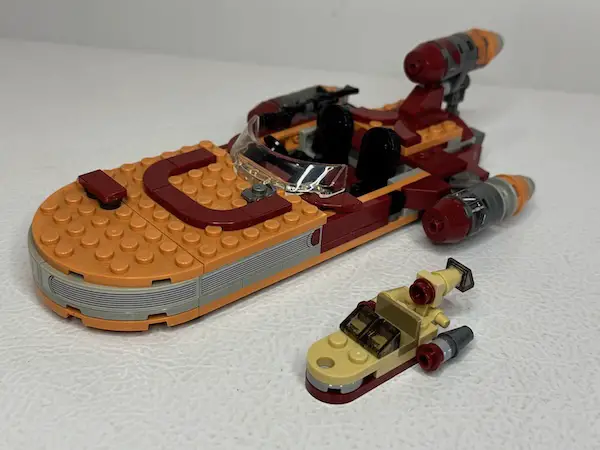
Luke Skywalker’s X-34 Landspeeder is arguably one of the most unremarkable vehicles in all of Star Wars. It’s a beat-up, three-engined desert hooptie that appears for maybe ten minutes in A New Hope before Luke sells it to pay Han Solo for a ride. And yet, in the world of LEGO Star Wars, it has become the set that simply will not die — remade so relentlessly over the past 25 years that the LEGO fan community has turned it into something of a running joke. Here’s the full story of every version LEGO has produced, why the secondary market has effectively shrugged, and why the company keeps cranking them out anyway.
For Luke’s Landspeeder, which I almost always have one in stock, and other LEGO Star Wars sets for sale, visit my eBay Store.
LEGO Luke’s Landspeeder: The complete lineage, brick by brick
Set #7110 – Landspeeder (1999)
The very first LEGO X-34 Landspeeder was among the earliest wave of LEGO Star Wars sets that debuted in 1999 alongside The Phantom Menace, and for five years, set 7110 — which included minifigures of Luke Skywalker and Ben Kenobi — would remain the definitive LEGO version of the vehicle. It had just 47 pieces and was built in tan with red on the sides. Dated by today’s standards, certainly, but it carries that unmistakable late-’90s LEGO charm that a certain generation of collectors holds very dear.
Set #4501 – Mos Eisley Cantina (2004)
The LEGO Group’s first take on Mos Eisley saw a huge chunk of its 193 pieces devoted to a new version of Luke’s Landspeeder at minifigure scale. This time, the designers opted for sand red instead of tan for its base color, but the single-piece engines and inaccurate windshield remained. The Landspeeder was essentially a side dish to the main course here — bundled into a larger playset alongside a Dewback and the Cantina itself.
Set #8092 – Luke’s Landspeeder (2010)
Reverting back to tan for the last time at this scale, set 8092 focused on A New Hope’s “these aren’t the droids you’re looking for” scene in its minifigure selection, which expanded on the original with C-3PO, R2-D2, and a Sandtrooper. It was also the first Landspeeder to make use of a new curved windscreen introduced in the Speed Racer theme in 2008. At 163 pieces, the speeder seated two minifigures and featured a hidden compartment under the top engine for storing lightsabers.
Set #75052 – Mos Eisley Cantina (2014)
The Cantina was revisited, and sure enough, the Landspeeder came along for the ride again. This version is notable for setting the template for almost every X-34 Landspeeder since, mainly through its use of nougat — a warm tan-beige — as a base color. Its tube design would also reappear in later releases.
Set #75173 – Luke’s Landspeeder (2017)
The 2017 standalone set featured a two-minifigure open cockpit, three engines, and an opening trunk to store Luke’s electrobinoculars, and came with Luke Skywalker, Ben Kenobi, C-3PO, a Tusken Raider, and a womp rat. At 149 pieces for around $20, it was a solid entry-level set — arguably the sweet spot of the minifigure-scale era.
Set #75271 – Luke Skywalker’s Landspeeder (2020)
The 2020 version came with 224 pieces and was a further improvement of the similar set released three years earlier, making clever use of newer bracket pieces to enable more sideways building techniques. At the same price of roughly $30, buyers settled for three minifigures — Luke, C-3PO, and a Jawa — compared to the 2017 version’s four figures plus a womp rat.
Set #75341 – Luke Skywalker’s Landspeeder UCS (2022)
Released in May 2022 and retired in December 2024, the UCS version contained 1,890 pieces with a retail price of $239.99. It featured a cockpit with a driving stick and detailed dashboard display, and could be displayed in “hover” mode on an information plaque. It was the first — and so far only — Ultimate Collector Series version of the vehicle, finally giving the most-remade set in the LEGO Star Wars lineup its flagship treatment.
The cameos, charms, and convention exclusives
The standalone sets don’t tell the whole story. One of the earliest LEGO bag charms tackled the Landspeeder — because this is clearly a vehicle iconic enough to carry around with you. A miniature version was included in the 2014 advent calendar. A convention-exclusive micro version was handed out to the first 200 people to show up at the LEGO stand at New York Comic-Con in 2012, and it commands serious money now. A bright red, barely-recognizable rendition was bundled with the official LEGO Star Wars magazine in 2016. And the 2021 May the Fourth promo set #40451 (Tatooine Homestead) included a microscale Landspeeder built from just three pieces.
The eBay problem: a market flooded with familiarity
If you’ve browsed the secondary market for LEGO Star Wars, you’ve probably noticed that the Landspeeder is not exactly a hot commodity. The data tells the story plainly. The UCS set 75341, despite retiring in December 2024, has actually lost roughly 23% of its value since retirement, currently trading around $183 on the resale market against an original retail price of $239.99. That’s a rare and significant negative return for a retired LEGO set — especially a UCS release, which typically appreciates. The minifigure-scale versions fare similarly, with set 75271 trading at around $50.
Why the soft demand? A few factors converge.
Saturation is the primary culprit. Since 2010, there has always been a Luke’s Landspeeder available for sale at retail. When a set is perpetually available at MSRP, the secondary market simply never develops the urgency that drives prices up. Collectors who want one can usually just wait for a sale at Target or pick one up fresh from LEGO’s own website.
The minifigures aren’t exclusive enough either. Much of the value in LEGO Star Wars resale comes from rare or exclusive minifigures. None of the minifigures in the UCS set are exclusive — they all appear in other LEGO sets. Luke in his farmboy outfit and C-3PO are among the most reprinted characters in the entire theme.
Collector fatigue is real, too. Years of LEGO Star Wars fans mocking LEGO for releasing iterations of Luke Skywalker’s Landspeeder so frequently culminated in the UCS form in 2022, but even then many fans questioned whether $240 was worth it for the vehicle. When the collector community has spent a decade joking about a set, it becomes very hard for that same set to command a premium on the resale market.
So why does LEGO keep making it?
The answer is both simple and a little frustrating for longtime fans: it sells. Just not to them.
LEGO’s licensing agreement with Lucasfilm requires the company to maintain an active Star Wars line, and that line must serve a broad audience — not just adult collectors who’ve been buying sets since 1999. The target audience for LEGO overall still remains children, and kids don’t have much money to go around. A $20–$30 Landspeeder set featuring the most iconic character from one of the most beloved franchises in history is, frankly, a very easy sell to parents and grandparents.
There’s also the matter of building technique evolution. Each new Landspeeder has genuinely introduced improvements: new color choices, updated windscreen parts, better engine construction, and more refined proportions. Unlike never-ending versions of the Landspeeder, many other beloved sets have only ever been made once — meaning for the LEGO design team, the Landspeeder is also a useful canvas to showcase what new brick technology can accomplish.
And then there’s the nostalgia engine. The Landspeeder has become a staple of LEGO Star Wars, graduating from a 49-piece starter set in 1999 all the way to a nearly 1,900-piece display model in 2022. Every few years, a new wave of young Star Wars fans discovers the franchise and wants their own version. LEGO is simply there to meet them.
Luke’s LEGO Landspeeder: The bottom line
Luke’s Landspeeder is LEGO Star Wars in miniature: iconic, endlessly iterated upon, beloved by newcomers, and a source of mild exasperation for collectors who’ve bought three versions already. The secondary market reflects this reality — when something has been on shelves continuously for 15 years, the scarcity that drives resale premiums never really forms.
If you’re buying for nostalgia, the 1999 original has a charming retro quality. If you’re buying for play, the 2017 or 2020 minifigure-scale versions offer the best value. And if you want the best-looking version ever made, the UCS 75341 is genuinely impressive — even if the aftermarket would suggest the rest of the collecting community isn’t exactly scrambling for it. At this point, Luke should probably just keep the speeder. He’s going to find it waiting for him the next time LEGO decides it’s time for another remake.